
 Send Email
 18929582815






Understanding the G0512 Multi-Head Architecture: A Look Into INCODE’s Next-Generation Design
Why Multi-Head Systems Are Becoming Essential
In industries such as corrugated packaging, building materials, and logistics labeling, products often require larger codes, multiple print positions, or synchronized information across a wide surface.
Traditional single-head printers struggle to maintain consistency when coverage requirements increase.
“Multi-head printing is no longer about printing more,” explained an INCODE system engineer.
“It’s about maintaining accuracy and synchronization when the system becomes more complex.”
This challenge became the starting point for the G0512 design.
Inside the G0512 Architecture
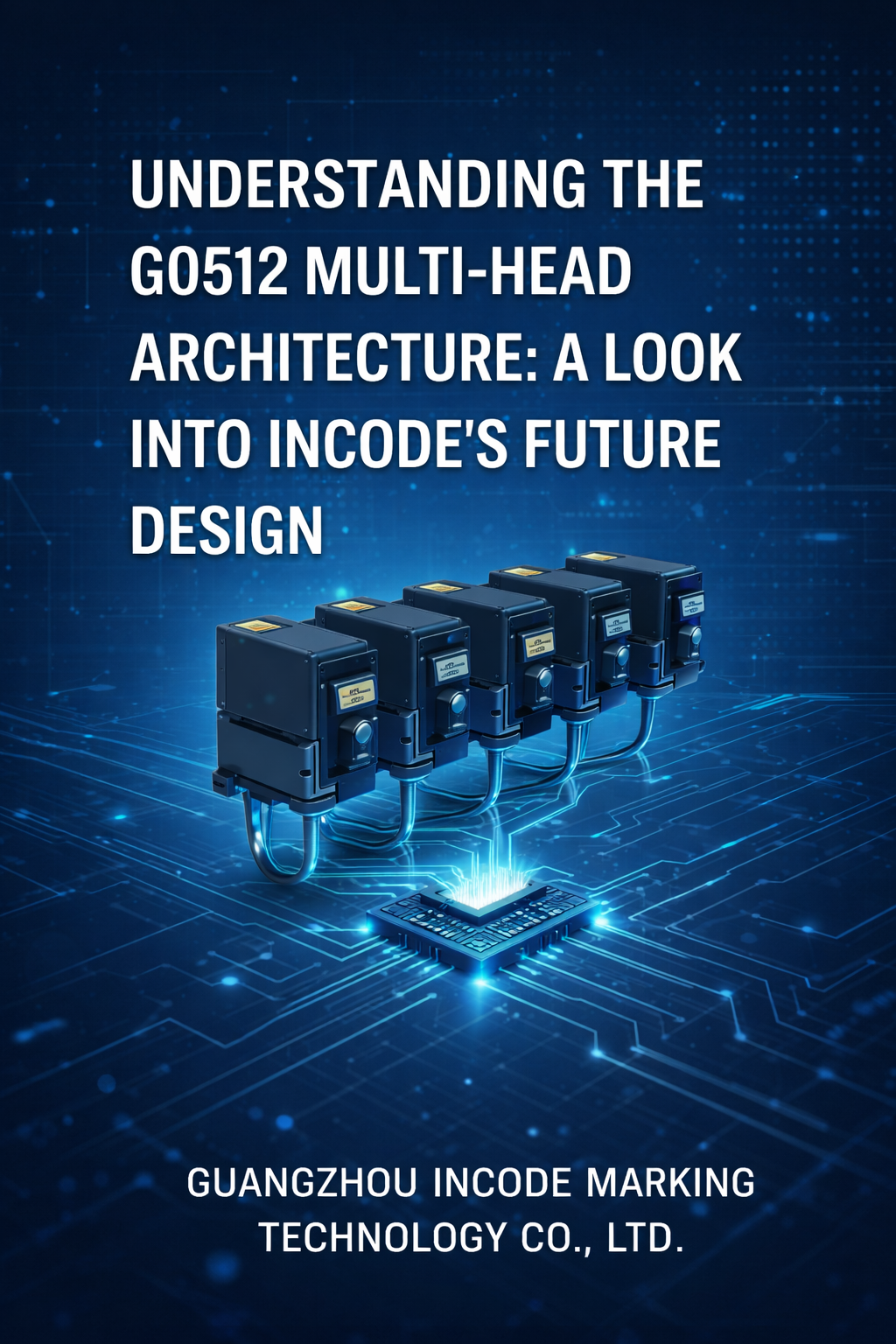
The G0512 platform is engineered to support up to eight printheads, working together as a coordinated system rather than independent units.
Key architectural features include:
Centralized Data Management
All variable information is processed centrally to ensure each printhead receives synchronized data without timing drift.
High-Speed Signal Transmission
Compared to earlier designs, the G0512 adopts upgraded communication lines to significantly increase data transfer speed between the processor and printheads—an essential factor for variable codes and large-format printing.
Distributed Printhead Control
Each printhead is equipped with localized control logic, allowing faster response times and reducing the load on the main processor.
This layered structure improves stability while making future expansion easier.
Designed for Variable Data and High Workloads
Variable data printing—such as serial numbers, QR codes, and batch information—places heavy demands on processing speed.
In the G0512 system, INCODE introduced a pre-generation and buffering concept, where multiple sets of variable data are prepared in advance and stored close to the printhead.
This approach allows the system to:
-
reduce latency during high-speed operation
-
maintain consistent print quality regardless of data complexity
-
avoid missed or incomplete prints on fast-moving lines
“Instead of reacting to data in real time, the system stays one step ahead,” noted a member of the R&D team.
Scalability as a Core Design Principle
One of the defining goals of the G0512 project was scalability.
Manufacturers can start with fewer printheads and expand the system as production requirements change—without replacing the entire printer.
This modular philosophy aligns with INCODE’s broader strategy:
build systems that grow with the customer, not systems that limit them.
Testing and Validation at the INCODE Evaluation Center
Before entering the market, the G0512 architecture is undergoing extensive testing at INCODE’s Service & Evaluation Center, including:
-
multi-head synchronization accuracy
-
long-duration variable data stress tests
-
thermal and electrical stability under full load
These tests help ensure that added complexity does not compromise reliability—a critical requirement for real production environments.
Looking Ahead: From Hardware to Intelligent Systems
The G0512 platform represents more than a new machine.
It marks INCODE’s transition toward intelligent, scalable coding systems that combine hardware design, software logic, and real-world testing.
“Our goal is not to build the biggest system,” an INCODE project manager summarized.
“It’s to build the most controllable one.”
As manufacturers move toward wider formats and more data-intensive coding, the G0512 architecture is positioned to meet those demands with precision and confidence.