
 Send Email
 18929582815






Inside the Technology: How INCODE Ensures Accuracy and Stability in Every Print
The Modular Architecture Behind Every Printer
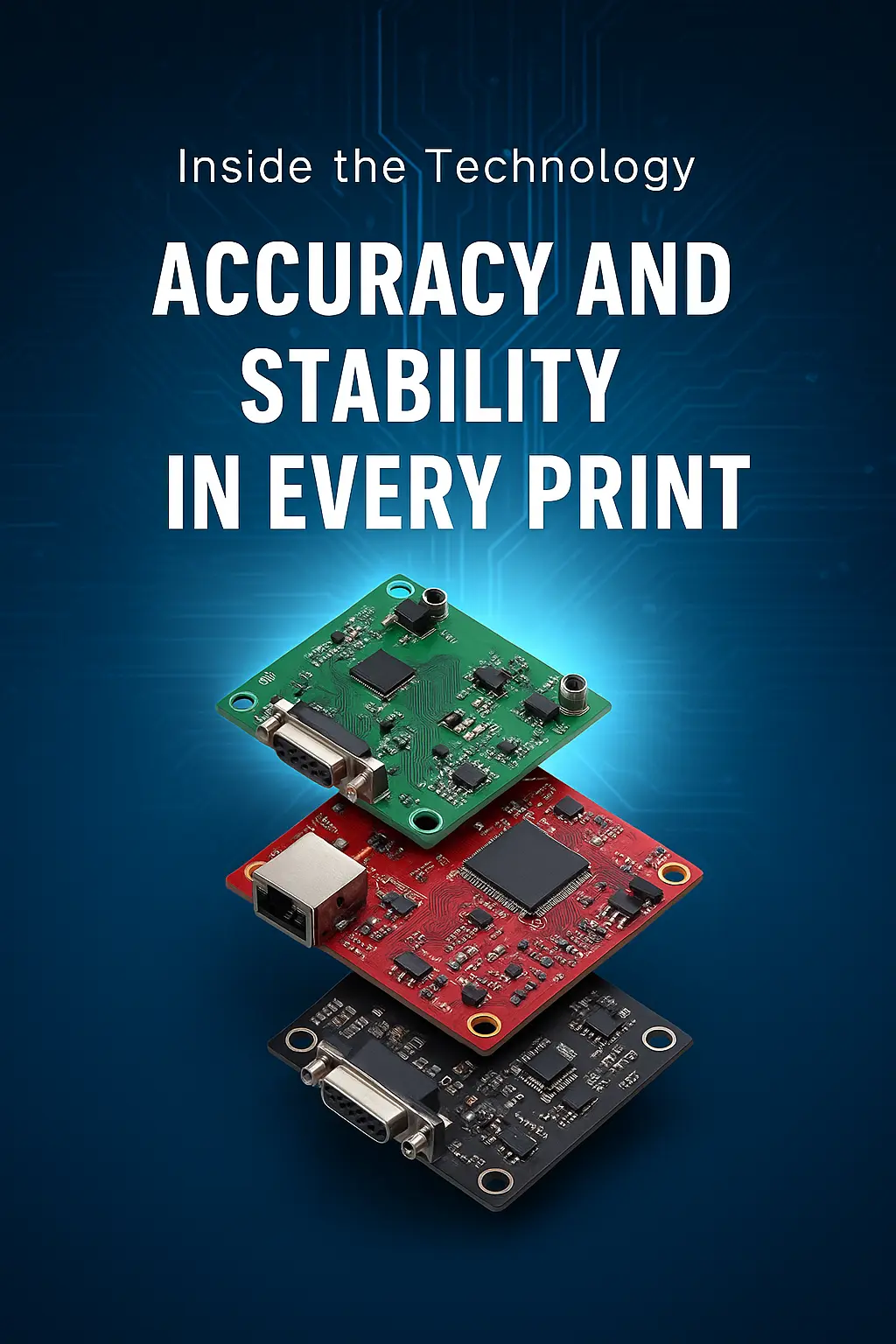
Every Incodeonline inkjet printer is built on a modular system of three core control boards — the green display driver board, the red data processor, and the black printhead controller.
Each board plays a specific role in guaranteeing synchronized performance:
-
The green board controls the interface and ensures real-time feedback for operators.
-
The red board, essentially the brain of the system, processes data and manages dynamic variable codes.
-
The black board governs printhead performance, balancing current and timing signals for precise droplet ejection.
“Our modular design isn’t just for convenience,” explained an INCODE electronics engineer. “It’s how we isolate and optimize each process — from display to data to droplet.”
This separation of functions minimizes cross-interference, making maintenance easier and extending the system’s operational lifespan.
Precision Engineering Down to the Micron
INCODE’s R&D engineers understand that printing precision depends on control — of both mechanics and physics.
To achieve this, the company developed a proprietary timing synchronization algorithm that regulates how the printhead responds to sensor signals and conveyor speed.
In practical terms, this means that even if the production line changes pace mid-operation, the printed characters maintain exact proportions, avoiding distortion, stretching, or overlap.
Testing data from the INCODE Evaluation Center shows dimensional deviations of less than 0.2 mm per meter of printed content — a benchmark rarely achieved in compact TIJ systems.
The Science of Stability
Beyond precision, reliability defines INCODE’s reputation.
One of the company’s key breakthroughs lies in its anti-static and power feedback protection system — an innovation introduced after extensive field analysis of nozzle failures caused by static discharge or back-current.
The latest generation of black control boards includes multilayer protection circuits that absorb voltage spikes and isolate short-circuit feedback.
This improvement has reduced field failure rates by over 60%, even in high-humidity or high-dust environments.
“Our philosophy is simple: every component must fail gracefully,” said an INCODE hardware engineer. “If something goes wrong, the system should protect itself — not burn out.”
Tested for Real-World Production
Each INCODE printer undergoes more than 100 hours of continuous testing before shipment.
This process includes vibration, heat, and humidity cycles that simulate real production conditions — from tropical food factories to dry electronics assembly lines.
The TIJ ink cartridges are also tested under variable temperature and decap scenarios, ensuring a 24-hour open time without clogging or fading.
This consistency allows customers to run long production shifts with minimal manual intervention.
The Future of Printing Precision
INCODE’s engineering team is now integrating AI-driven correction algorithms that will automatically detect and adjust for micro-deviations in printhead performance.
These systems will analyze droplet patterns in real time, ensuring each mark remains as sharp and uniform as the first — even after thousands of cycles.
“Precision is not a one-time achievement,” noted an INCODE technical director. “It’s a process of continuous learning and refinement.”
With every iteration, Guangzhou INCODE Marking Technology Co., Ltd continues to set new standards for print reliability, proving that true precision is built, tested, and perfected — one drop at a time.