
 Send Email
 18929582815






INCODE Introduces Dust-Chamber & Multi-Ink Testing to Advance Real-World Printhead Evaluation
Why Dust and Ink Compatibility Matter More Than Ever
Factories today operate in increasingly diverse environments — from powder-filled packaging plants to high-humidity food workshops and UV-curing labeling lines.
Printheads face more than just speed and workload; they must withstand airborne particles, chemical residues, and continuous temperature variations.
INCODE’s testing team determined that these challenges could not be fully represented by standard lab procedures alone.
As Test Supervisor Lin Qiang explained:
“Many failures don’t come from the printhead itself, but from the environment it has to survive. Our job is to recreate those conditions before the customer experiences them.”
This perspective became the foundation for Week 16’s enhanced testing modules.
What Was Added to the Testing Program This Week
1. Dust-Chamber Simulation: Realistic Contamination Exposure
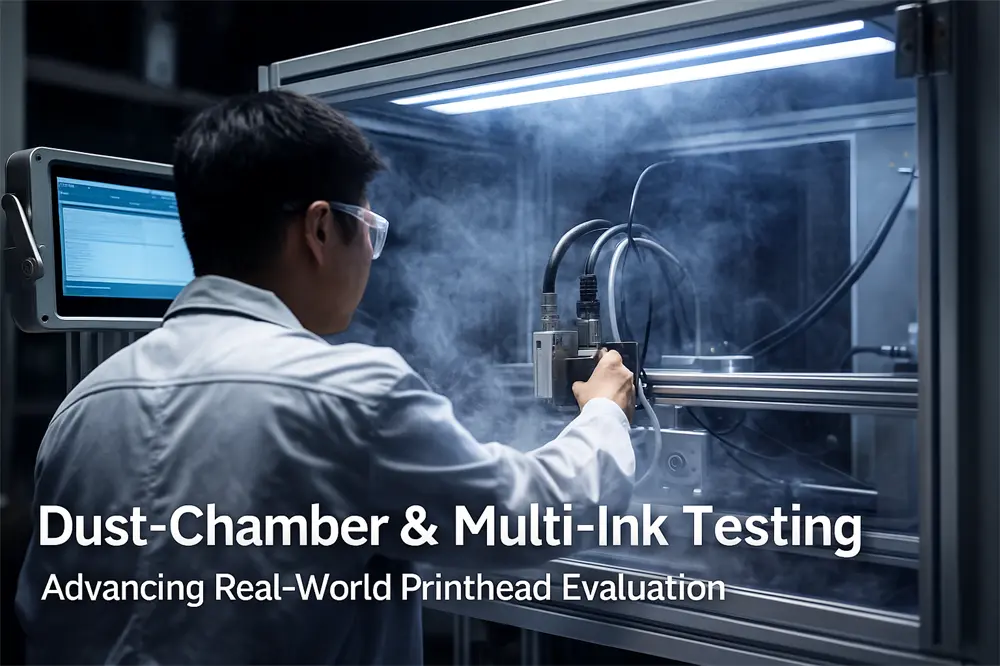
INCODE built a controlled dust environment designed to mimic common production contaminants such as:
-
powder-based raw materials
-
carton fiber dust
-
plastic shavings
-
product debris from high-speed trimming lines
Inside the chamber, printheads are operated for extended cycles while cameras capture nozzle behavior, airflow response, and ink droplet consistency.
2. Multi-Ink Switching Test: From Black to White to UV
To study ink flow stability and compatibility, printheads now undergo:
-
solvent black ink printing
-
pigment white ink testing
-
UV ink trials under regulated curing conditions
Engineers alternate inks without replacing the head to monitor residue accumulation, membrane swelling, and response time.
3. Real-Time Behavior Mapping
A new tracking module has been introduced to compare:
-
droplet angle deviation
-
line density stability
-
recovery time after nozzle self-cleaning
-
sensitivity to dust blockage
Data is logged continuously to support predictive maintenance modeling.
Early Findings: Conditions Change, Printhead Behavior Reveals Patterns
After the first 48 hours, engineers observed several useful insights:
-
UV ink revealed faster buildup on dusty surfaces — confirming real-world customer reports
-
Pigment white ink displayed excellent recovery after short cleaning intervals
-
Dust particles caused measurable but predictable droplet deflection, helping establish new calibration margins
-
The upgraded printhead structure showed strong resilience during rapid ink switching
These findings are now being compared with field data from INCODE’s overseas partners.
Engineer Zhao Ming commented during a review session:
“When we combine lab simulations with what customers see on the line, the patterns start to match. That’s when testing becomes genuinely valuable.”
What This Means for Customers
The new testing modules will allow INCODE to:
-
Recommend printheads and inks based on environmental risk
-
Provide maintenance intervals backed by measurable data
-
Improve design tolerances for dusty or pigment-heavy environments
-
Support distributors with more accurate troubleshooting guidance
This aligns with INCODE’s long-term goal of turning evaluation into a service — not just an internal procedure.
Looking Ahead: Toward an Industry-Wide Stability Standard
In the coming weeks, INCODE will integrate these results into a broader printhead life-curve model, combining:
-
speed endurance tests
-
temperature cycles
-
dust exposure data
-
ink-switching durability metrics
The aim is to establish a practical, evidence-based benchmark that customers can rely on when selecting equipment for different industries.
As an INCODE spokesperson summarized:
“We want manufacturers to choose coding equipment with clarity, not guesswork. That begins with honest testing.”