
 Send Email
 18929582815




INCODE Experts Share Insights on the Future of Industrial Coding and Smart Manufacturing
The Industry Is Moving Toward Intelligence
Traditional coding systems once focused only on speed and accuracy. Today, factories expect much more — integration with MES and ERP systems, automated data management, and the ability to adapt instantly to different products on a production line.
“Industrial marking has become a key part of the digital factory,” said one of INCODE’s senior engineers. “It’s no longer a separate device — it’s part of a connected ecosystem.”
INCODE’s online inkjet printers are already designed with this shift in mind. Their modular architecture and high-speed data processing allow them to communicate with external devices such as barcode scanners, weighing systems, and vision inspection modules.
This level of connectivity turns printing from a simple coding task into an intelligent data process — essential for modern traceability and quality control.
Sustainable and Efficient Printing Becomes the New Standard
Environmental responsibility is another defining trend.
Manufacturers are looking for inks that perform well while minimizing chemical emissions and waste. INCODE’s eco-friendly solvent ink, developed through in-house chemical synthesis, offers strong adhesion, low odor, and a 24-hour open time (decap time) that minimizes cleaning and cartridge waste.
“Sustainability doesn’t mean compromising performance,” explained INCODE’s R&D Manager. “We have proved that long-decap, low-VOC inks can outperform conventional ones in both stability and durability.”
This balance between ecological awareness and industrial reliability positions INCODE as a pioneer in sustainable printing solutions.
Building Smarter Service Through Data
The shift toward data-driven maintenance is also shaping INCODE’s strategy.
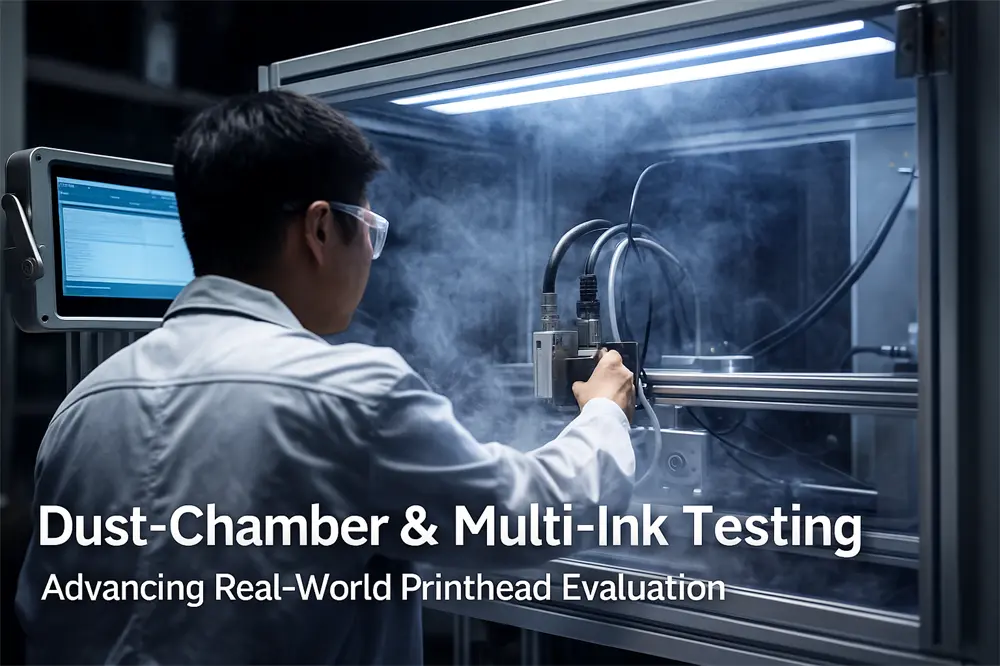
Through its Service & Evaluation Center, INCODE collects real-world usage data from global clients — information about environmental conditions, printhead performance, and ink behavior.
These insights are used to predict potential maintenance needs and optimize after-sales response times.
As a result, customers benefit from faster troubleshooting, longer equipment lifespan, and fewer interruptions on the production line.
This proactive approach turns INCODE’s support service into a predictive system — one that helps customers maintain peak efficiency rather than react to failures.
Global Collaboration and Knowledge Sharing
INCODE’s technical teams collaborate closely with partners in Asia, South America, and Europe, conducting joint research on print quality consistency, temperature effects, and new substrate compatibility.
Through quarterly knowledge exchanges and internal workshops, INCODE engineers share field experiences that inspire product refinements.
“Every new project is a collaboration,” said an overseas technical director. “Our partners bring real-world challenges, and together we turn them into new technical breakthroughs.”
The Road Ahead: Integration, Intelligence, and Trust
Looking ahead, INCODE plans to further integrate AI-assisted printing control, enabling automatic adjustment of ink pressure, droplet size, and line spacing in real time.
Future systems will include smart sensing modules capable of detecting print errors or ink flow issues before they affect production.For INCODE, this vision goes beyond hardware — it’s about shaping the future of industrial coding through intelligent design, global collaboration, and unwavering reliability.
“Our mission is simple,” summarized an INCODE spokesperson. “We aim to be the trusted expert that helps every manufacturer print smarter, faster, and cleaner.”