
 Send Email
 18929582815






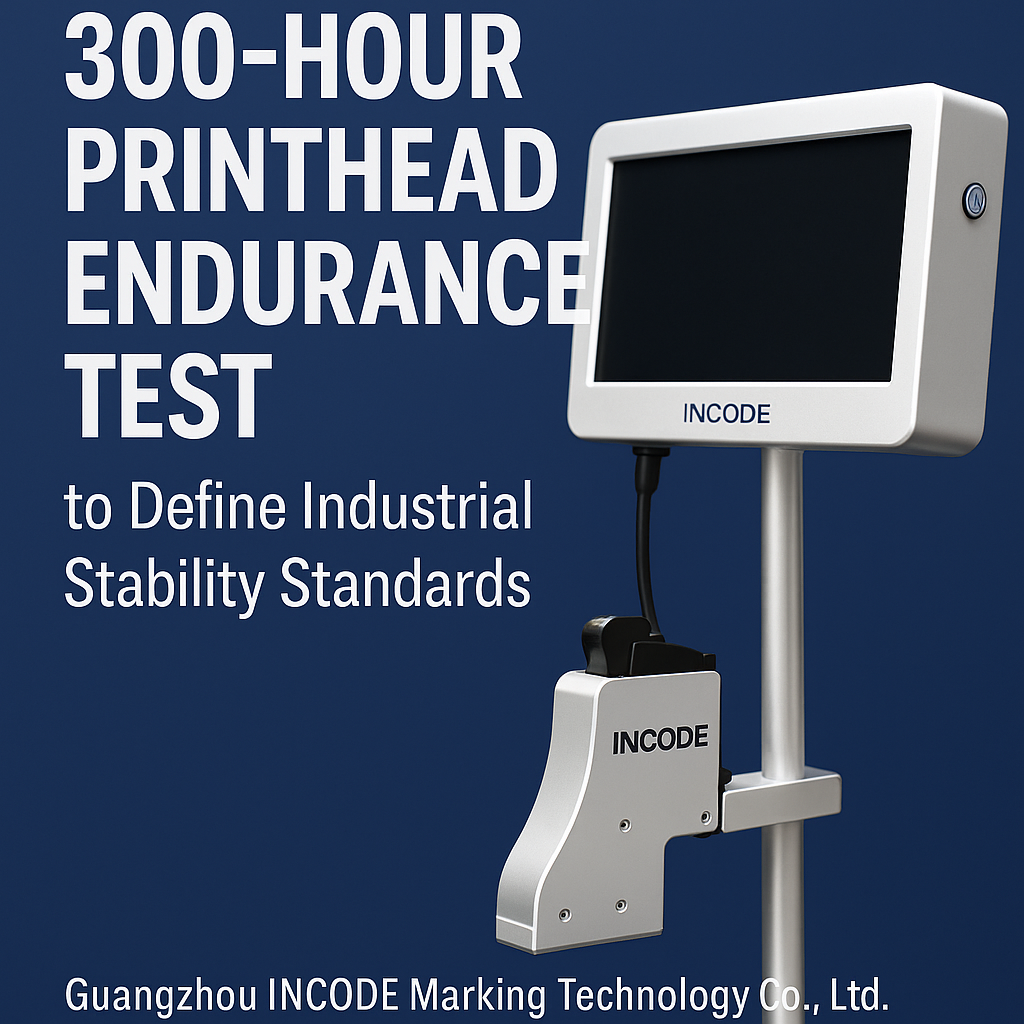

INCODE Begins a 300-Hour Printhead Endurance Test to Build a Clearer Reliability Benchmark for the Industry
Why This Test Matters: Real Production Runs Don’t Pause
In many factories, coding equipment operates far beyond standard laboratory test durations. Temperature shifts, long shifts, and back-to-back Batches create conditions where printheads face slow, gradual changes that aren’t immediately visible.
As Zhang Rui from the INCODE testing team explained during the experiment briefing:
“Customers aren’t only focused on print quality today. They want to know what the print looks like after weeks of real production. Our job is to document that behavior honestly.”
This perspective guided the design of the 300-hour test.
How the Test Is Being Conducted
To keep the evaluation aligned with real-world environments, INCODE structured the test into several stages:
1. Continuous High-Speed Printing for 300 Hours
-
Non-stop printing with scheduled captures of printed samples
-
Speed calibrated to typical packaging and assembly line conditions
-
Output checked every two hours for variation trends
2. Controlled Temperature Cycling
The printhead is exposed to temperature ranges from 10°C to 45°C to simulate seasonal changes and facilities without precise climate control.
3. Structural Observation
High-magnification tools examine nozzle plates and internal brackets to detect early fatigue or material shifts.
4. Side-by-Side Comparison of Two Printhead Versions
A newer revision is evaluated next to an older version to understand how structural updates affect long-term stability.
Early Observations: Stable, Predictable Performance
Halfway into the experiment, several patterns have emerged:
-
Print consistency remained highly stable with only slight variance
-
The cooling system maintained steady thermal behavior
-
Minor ink residue appeared after extended use but was easily managed with routine cleaning
-
No structural abnormalities were identified in the preliminary inspections
Engineer Liu Hang summarized the findings in a practical way:
“So far, the printhead behaves exactly how an industrial customer would hope—no surprises, no sudden dips.”
What Comes Next: Dust, Multi-Ink Testing, and Life Modeling
The Service & Testing Center plans to expand the test in Week 16:
-
Dust-environment simulations
-
Ink type compatibility checks (including white and UV inks)
-
Predictive modeling to estimate printhead lifespan under different workloads
These additions aim to help customers compare equipment more transparently across brands—something the market lacks despite growing demand for reliable long-term data.
INCODE’s Broader Goal: Make Testing a Service, Not an Internal Process
As part of its continued investment in testing capability, INCODE intends to share more long-term performance insights publicly. This aligns with the company’s broader positioning:
expert guidance + transparent evaluation = more confidence for production managers.
The 300-hour printhead endurance project is one step toward building a clearer standard for the coding industry—one based on measurable evidence rather than assumptions.