How to Choose the Best Fiber Laser Marking Printer for Your Needs
In today's manufacturing environment, selecting the right Fiber Laser Marking Printers can significantly impact business efficiency. The global fiber laser marking machine market was valued at nearly $1 billion in 2022 and is projected to grow by 12% annually through 2030. This growth reflects how industries are increasingly relying on advanced marking solutions.
When evaluating these printers, consider their precision and speed. The best models can mark on various materials, from metals to plastics. However, not all options meet every need. Businesses often struggle with customization and support. Misleading marketing can lead to poor purchases.
Investing in the right Fiber Laser Marking Printer is vital. Prioritize features that align with your specific applications. With careful consideration, you can avoid costly mistakes and enhance production quality.
Understanding Fiber Laser Marking Technology and Its Applications
Fiber laser marking technology is revolutionizing various industries, offering precision, speed, and durability. This technology uses a concentrated beam of light to create permanent marks on materials. Reports indicate that the fiber laser marking market is projected to grow at a CAGR of 8.5% from 2022 to 2030. This growth is driven by the demand for high-quality marking solutions in manufacturing, electronics, and medical sectors.
Applications of fiber laser marking are vast. They are ideal for engraving barcodes, serial numbers, and logos on different surfaces such as metals, plastics, and ceramics. The high intensity of fiber lasers ensures deep, clean marks. However, with the versatility comes complexity. Different materials react differently to laser marking, and understanding this can be challenging for operators. Mistakes can lead to poor quality and excessive costs.
Choosing the right fiber laser marking printer can be daunting. Factors such as power, marking speed, and wavelength need careful consideration. A mismatch can result in unclear markings or overexposure of the material. It's essential to balance performance with practicality. Not all applications demand the highest power settings. Sometimes, a lower setting can provide sufficient results while minimizing waste.
Comparative Analysis of Fiber Laser Marking Printer Features
Key Factors in Selecting the Right Fiber Laser Marking Printer
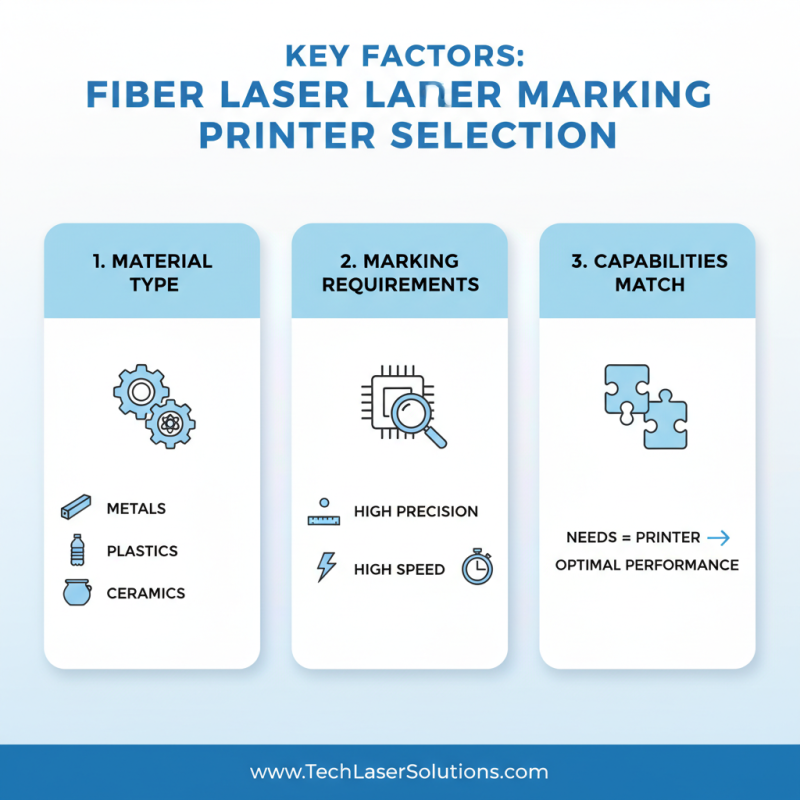
When selecting a fiber laser marking printer, key factors must be considered. Understand your material type. Different fibers work best on metals, plastics, or ceramics. Assess your specific marking requirements. Are you looking for high precision or speed? Matching the printer's capabilities to your needs is crucial.
Pay attention to maintenance and serviceability. Printers require regular upkeep. An easy-to-service machine reduces downtime. Check the availability of spare parts and technical support. You don’t want to be left stranded during busy periods. User-friendliness is also vital. A complex interface can lead to mistakes. Ensure operators can learn the system quickly, even when under pressure.
Lastly, think about the machine’s footprint. Space can be limited in production areas. Choose a size that fits your space without compromising functionality. Consider the power requirements as well. Higher power can mean faster marking, but it could also lead to higher energy costs. Balancing these aspects requires reflection on both current and future needs.
Comparing Features: Speed, Precision, and Wavelength in Laser Marking
When selecting a fiber laser marking printer, speed, precision, and wavelength are crucial factors. Speed often dictates productivity rates. Some advanced models can mark at speeds up to 5,000 mm per second. This is beneficial for high-volume production lines. However, if the laser speed exceeds material compatibility, quality could deteriorate. Balancing speed and material requirements is essential.
Precision plays a vital role in laser marking. High-quality printers can achieve markings as fine as 20 microns. This level of detail is important for industries like electronics and jewelry. Yet, achieving such precision may increase production time. A slower, more precise mark can sometimes yield better results than a fast but coarse mark. Consider how this impacts your overall process efficiency.
Wavelength is another feature to evaluate. Different materials respond differently to laser wavelengths. For example, metals often require a wavelength of 1064 nm for optimal marking. However, plastics might need a different wavelength range for effective results. This variance can affect your choice, especially in multi-material operations. Selecting the correct wavelength can significantly enhance engraving quality.
How to Choose the Best Fiber Laser Marking Printer for Your Needs - Comparing Features
| Printer Model |
Speed (mm/s) |
Precision (μm) |
Wavelength (nm) |
Cooling Type |
| Model A |
100 |
20 |
1064 |
Air Cooling |
| Model B |
80 |
25 |
1064 |
Water Cooling |
| Model C |
120 |
15 |
1064 |
Air Cooling |
| Model D |
90 |
30 |
1064 |
Water Cooling |
Evaluating Cost-Effectiveness and ROI for Fiber Laser Printers
When evaluating fiber laser printers, cost-effectiveness is essential. A report by Markets and Markets indicates that the global fiber laser market is expected to reach $4.9 billion by 2025, growing at a CAGR of 9.4%. This growth reflects increasing demand across industries like automotive, aerospace, and electronics. However, the initial investment can be substantial, often ranging from $10,000 to $100,000 depending on capabilities.
An analysis of ROI shows that companies can recoup their investment within 2-3 years through reduced operational costs. Fiber lasers are known for their efficiency and low maintenance. For instance, they consume up to 70% less energy than traditional engraving machines. Companies using fiber lasers report a 30% increase in productivity. Yet, the pricing structure can be complex. Factors like application type, material compatibility, and required speed influence overall costs.
In making the right choice, consider both direct and indirect costs. Training employees, maintenance, and potential downtime are factors that often get overlooked. A less expensive printer may have hidden costs that diminish savings. Engage with industry experts to analyze your specific needs. It can save you from regrets later. Making a wise investment in fiber laser technology requires thorough evaluation. Understanding all financial aspects is key to customer satisfaction and operational excellence.
Maintenance and Support Considerations for Laser Marking Equipment
When selecting a fiber laser marking printer, consider maintenance and support. Regular upkeep ensures longevity. It minimizes downtime and enhances productivity. Choose a printer with readily available support. Availability of technical assistance can be a game changer.
Tips: Look for equipment with clear maintenance guidelines. This will help you perform regular checks efficiently. A well-documented schedule can simplify the process.
Also, think about replacement parts. Ensure that components are accessible. Some printers may have fewer options, leading to longer repair times. A delay can hurt your workflow.
Ultimately, assess your specific needs. A system that lacks strong support can be frustrating. Weigh the features against potential maintenance challenges. This will guide your decision.


 Send Email
 18929582815